PRAGUE, August 22, 2009 -- Could the Silk Roads have existed without camels?
After all, for thousands of years before and during the Silk Roads the wheel also existed across all of Eurasia, and wagons were used to carry heavy goods for long distances
The Central Asian nomads, for example, commonly used wagons to transport their possession across the steppes and at times even put their yurts – their round, rigid tents – on wheels to transport them.
And at both the Eastern end of the Silk Roads in China and the Western end in the Middle East, the countryside was teeming with on- and off-road wheeled vehicles of all kinds, from horse drawn chariots to carts to wagons.
The answer to why, despite this, the Silk Roads became entirely camel-driven can be found in a fascinating book by historian Richard W. Bulliet. The book is ‘The Camel and the Wheel’ (1975).
Bulliet explains how the camel, which became a transport animal long after the horse, proved so efficient for moving cargo that it not only made the Silk Roads possible it also completely replaced the use of wagons across a vast swath of the Middle East, from central Turkey to North Africa.
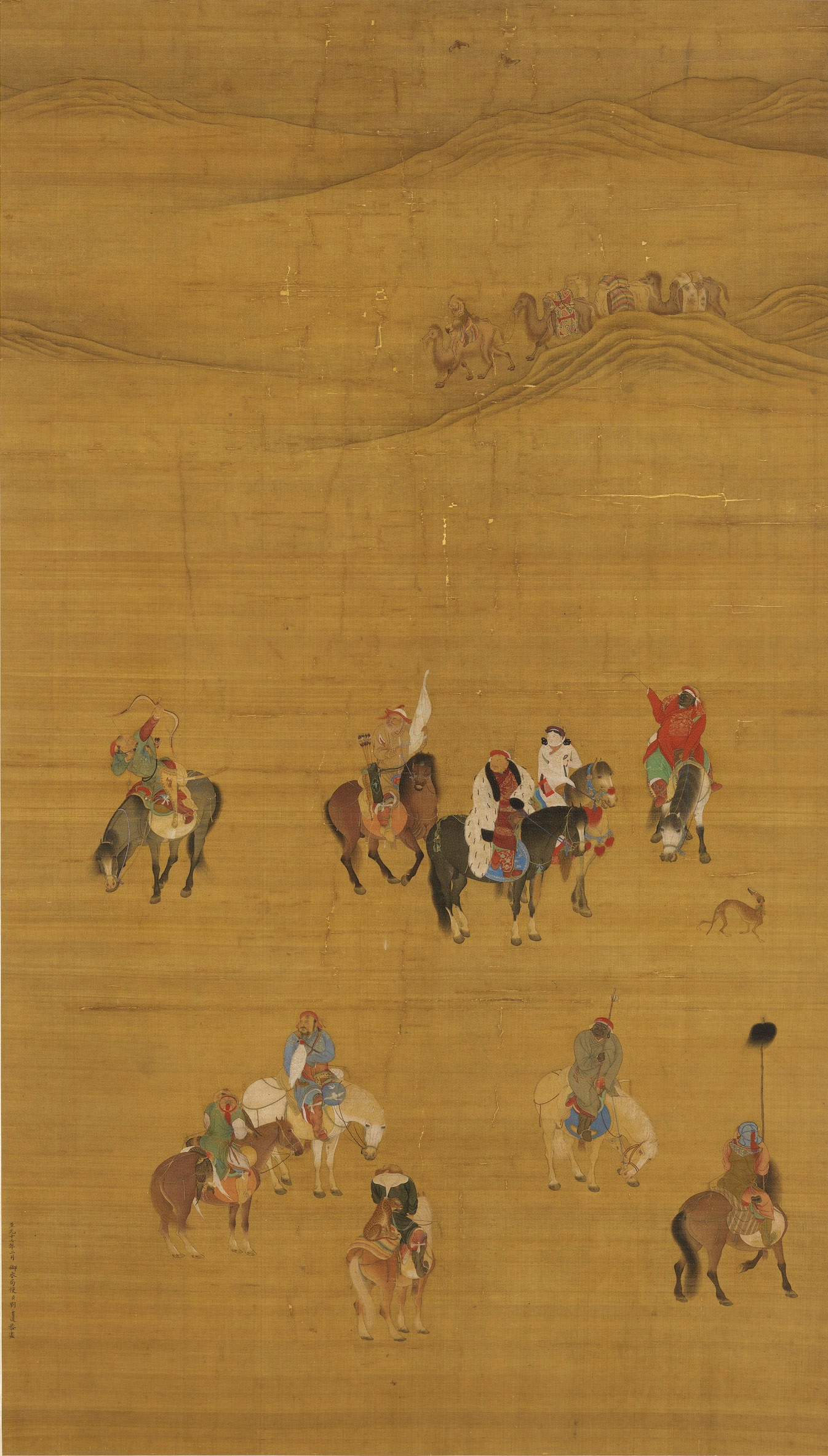
 Here is a Chinese scroll painting from 1280 by Liu Kuan-tao showing a camel caravan carrying carpets in the background of a scene of the Mongol emperor Kublai Khan hunting. For a close up: click here
What were a camel’s advantages over wheeled vehicles?
For one, a camel can match horse or ox-drawn wagons for load and speed. A camel can carry 300 to 500 pounds on its back and, walking at speed of two and-a-half miles an hour, travel 20 miles a day.
But where wagons are expensive to build and operate, a camel is relatively cost-free.
Its saddle requires little wood, which is a valuable commodity in arid parts of the world.
And unlike horses and oxen, camels don’t need special fodder or much water. They can eat desert plants and – when unburdened – go as much as two weeks without a drink of water. And when they do drink, they fill up fast, at the rate of 28 gallons in 10 minutes.
Best of all, once a camel drinks water, he does not lose it again quickly – thanks to an amazing physiology. A camel’s feces are dry and its urine viscous. It sweats only after first tolerating a rise in its body temperature of a full 10 degrees Fahrenheit. And when it does start perspiring, it can survive a water loss of up to one-third of its body weight, then drink again and continue on its way.
 All these factors made camel caravans incredibly cost-effective for overland travel.
 Bulliet writes that the Romans, for example, estimated camel transport was about 20 percent cheaper than wagon transport, according to an edict on prices issued by Emperor Diocletian in the third century AD.
And it's interesting to note that once the cost-effective camel, supplemented by donkeys for lighter loads, displaced the wheel in the Middle East, the wheel did not return again until the age of the automobile.
A French traveler, Volney, observed in the 1780’s that “"It is remarkable that in all of Syria one does not see a single cart or wagon."
Bulliet says that the evidence of that total displacement of wagons can still be seen today in the patterns of the narrow streets in the historic old quarters of many towns:
“Although camels themselves were not too widely used within the walls of medieval towns, it was they who caused the tradition of wheeled transport to vanish; and it is the absence of carts and wagons that accounts in large part for the layout of medieval Middle Eastern cities,” he writes.

On the Silk Roads, two-humped camels were used from China through Central Asia and one-humped camels were used in the Middle East.
At either end, the physical challenges for the camel caravans that trekked across the vast distances involved were staggering.
Many historians like to describe the journey as equivalent to crossing an ocean – an ocean which stretched across almost the entire width of Eurasia.
There were caravansarais in accessible areas where the camels and merchants could rest, sometimes even at the end of each days’ journey. But there also were inaccessible areas that had to be crossed at risk of life and limb for days at a stretch.
Marco Polo, the Venetian traveler of the 13th century, provides vivid descriptions of some of the dangers in the account of his travels from Venice to the court of Kublai Khan in Khanbalik (modern Beijing):
* The Pamirs -- From here, one travels three days east, always climbing, until you reach gigantic mountains which are said to be the highest in the world.
* Taklamakan Desert – Those who venture here must take great care not to
 become separated from the others … because if they lose contact with their fellow travelers, they will only find their friends again with great difficulty, for all around them arise other voices which seem to call their names. From such hallucinations, many who cross (these singing sands) perish.
 * Che-Si Corridor, near Kanju, China – Travelers do not dare to enter these mountains with any animals … because here a certain plant grows which is so poisonous that any animal who eats it is lost.
As Bulliet points out, a camel easily outperforms any other beast of burden in such in extreme places because, in fact, such places are its natural habitat.
For eons, the camel’s survival strategy has been to safeguard itself from predators by staying away from them. Over the course of its evolution, it deliberately abandoned the grasslands for the desert, where most predators cannot stand the extremes of heat and drought. And in this way, though it is totally defenseless and usually moves slowly, it has thrived.
Man originally domesticated the camel for milk and food. But those uses are negligible compared to the possibilities it offered as a pack-animal for long-distance travel and, ultimately, cross-continental caravans.
 The caravans of the Silk Roads could involve hundreds of camels at once, with a combined carrying capacity equivalent to a sea-going ship of their time. They were highly organized and carried not just goods but paying passengers along regular and established routes.
 A detailed idea of how they worked can be had from accounts as recent as the 1920’s, when camel caravans were still common in China’s eastern Xinjiang region – once a major crossroads of the Silk Roads.
This description comes from Owen Lattimore, who chronicled his travels with a caravan in his book 'Desert Road to Turkestan' (1929):
“A caravan could consist of 150 or so camels (8 or more files), with a camel-puller for each file. Besides the camel-pullers the caravan would also include a xiansheng (literally, "Sir" or "Mister," who was typically an older man with a long experience as a camel-puller, now playing the role of a general manager), one or two cooks, and the caravan master, whose authority over the caravan and its people was as absolute as that of a captain on a sea ship. If the owner of the caravan did not travel with the caravan himself, he would send along a supercargo - the person who will take care of the disposal of the freight upon arrival, but had no say during the travel. The caravan could carry a number of paying passengers as well, who would alternate between riding on top of a camel load and walking.”
The bonds that the camel handlers formed with their beasts can still be seen in traditions that remain strong in some places today.
 One is the sport of camel fighting – a sport which, unlike many animal fights, was developed to entertain spectators while minimizing the danger for the camels, which were too valuable to put at risk.
The picture here of a camel fight is from 1585, painted by Abd as-Samad in Mughal India.
Camel fights still draw crowds of camel devotees in Turkey in the winter, which is the camel’s mating season and the time when males will try to knock each other down to win the females’ attention.
The battles are not unlike Sumo matches.
To start, specially bred camels weighing as much as a ton are led toward each other. Sometimes, one will run away just at the sight of the other. Usually, they crash into each other and then begin a shoulder-to-shoulder shoving match.
Injuries are rare because the camels, which usually hurt each other by biting, have their mouths tied shut. But the camels are full of tricks with their front legs and long necks, which they use to trip each other in skillful ways.
 The fight ends when one camel flees, neighs out a call of surrender, or falls. The action, which can be hard to follow, is breathlessly called out play-by-play by a sports announcer.
Camel wrestling devotees in Turkey trace the sport back to the nomadic and caravan days of the region. The matches are spectacles that involve whole towns, with the camels paraded through the streets beforehand decked in mirrored blankets, bells, and colorful pompoms and accompanied by drummers and folk dancers.
Curiously, in a strange nod to the camel populations of both the Silk Roads’ eastern and western ends, the best fighting camels in Turkey are bred by mating a female camel with a single hump with a male camel with double humps.
What kind of prizes are at stake? From the sport’s earliest origins until today, that has never been in question. There is money to be made by betting, of course, but the symbol of victory that is awarded to the winner by the organizers is a carpet.
These days, the carpet is usually machine-made and of little value. But the practice recalls a time when, centuries ago on the Silk Roads, carpets were as much a form of currency as money.
(Illustrations from top to bottom: Tang dynasty terra-cotta camels, 618-907AD; Silk scroll painting of Kublai Khan Hunting by Liu Kuan-tao, 13th century; detail of camel carrying carpet from Liu Kuan-tao’s scroll; map of major Silk Road routes; NASA satellite image of Taklamakan desert; Bas relief, camel, Palazzo Mastelli, Venice; Mughal painting, 1585; Camel match, Selcuk, Turkey, 2000.)
Related Links:
Richard W. Bulliet: Why They Lost the Wheel, Saudi Aramco World, 1972
Stephen Kinzer, New York Times: On a Winter's Weekend in Turkey, The Camel Fight Is the Place to Be
#
RETURN TO HOME
#